Building a Better Team with DISC Training
Building a better team is something every business hopes for. It doesn’t have to be just a hope and a dream you can make it happen. Building a better team starts with DISC training. That’s because a foundation can be laid for the team to be able to understand one another and communicate more effectively. Team participants learn a common language. They also grow in understanding work styles, communication preferences, etc.
What to Expect at a DISC Training
The DISC training starts by teaching participants about the different styles, their needs, their motivators, and their “fuel.” Teams learn about their unique strengths and also their blind spots, differences in preferences, and work styles. This matters because so many times issues at work stem from not being property understood. People tend to look at things through their own unique style or lens. They often fail to look at things from another’s style. DISC allows people to see those different perspectives, to gain a new understanding and appreciation for one another.
After DISC training people often share the things that used to irritate them about their co-workers are no longer such a big deal. That is because they are able to see things from another style’s perspective. In fact, many people learn to leverage those differences to work better together. What might have seemed like a weakness can now be appreciated. They can invite another person to help with something that isn’t their strength. The best teams understand how to leverage strengths to work best.
Your DISC Assessment
After the DISC foundations are laid we get into each person’s personalized assessment. This is a time where we divide into work groups or teams that work together and we share the different results of our assessments. Teams get to hear from one another what matters most to them, how they are motivated, and what makes them feel appreciated. There are several pages with different aspects that make up the assessments and we walk through all of those together.
Your DISC Graph
One of the last pages of the DISC assessment is the graph page. This shows people their actual DISC personality blend. It is very informative for individuals. People can see what they need to feel energized and also what drains them. In fact, it’s a great reminder DISC isn’t about what someone can or cannot do. Most people can probably do a majority of jobs well. Rather, it is about what energizes a person. We know when someone is energized they likely do their best work. If you feel drained you might still like your job, but it’s vital you know how to recharge or burnout can happen. A lot of introspection comes from this part of the assessment.
Team Graph
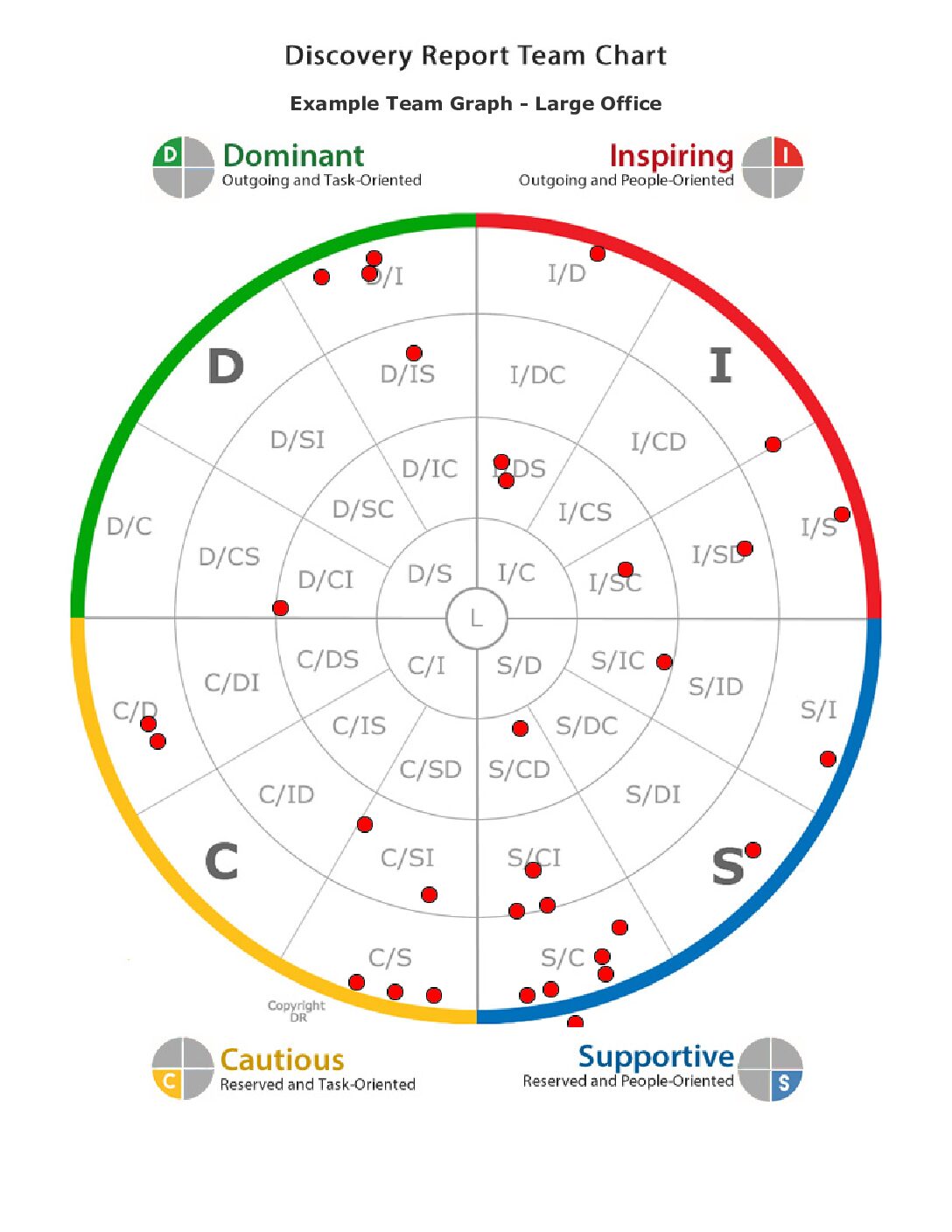
After the individual graph on the participant’s assessment we explore the team graph. This is where every person on the team is plotted on a chart. The visual representation of where everyone lands is an “aha” moment. People often describe this as one of the best parts of the training. It’s where things truly start to click. That person you thought was a jerk, distant, or mean? Nope. They are just on the opposite side of the team chart. The person you thought was too talkative, and too perky? Same thing. They are located on a different part of the chart. This truly brings the differences and similarities to light. Team members are able to laugh, talk, and truly start to get one another more fully.
The Great Conversations from DISC
From here we move into targeted discussions around similarities and differences and how we can respond better to one another. We do a variety of team exercises bringing the DISC alive. It’s not just theory, but real life. The team gets to put things into action. We talk about how we will take the DISC material and use it to impact our work groups, teams, and the business overall. How will we better serve one another and our customers? What are we learning? What will we apply? This is the good stuff. We’ve done the learning, the digging, and now it’s real world application. We know information doesn’t change us, but it’s the application of it does. We go through a series of different application exercises in different groups and people appreciate the candid conversations around real life topics.
Other Games and Application Exercises
Many times we include a more physical type game to anchor learning of material. We choose this based on the size of the team and the objectives we are trying to help reinforce. One of the favorites is the puzzle game. It’s a challenge to put pieces together while racing against the clock. We get to see leadership in action. Many great team nuggets come from these games. It’s a great close to the training session. We generally do a quick review of a key themes, show them a quick video that leaves folks laughing and end the day on a high note.
People love these DISC training sessions because they grow personally and professionally. The best teams don’t just make this a great training day, they take the concepts back and work to implement the training into their teams and culture. Of course, we help with that too when customers want the extra hand. There is a lot more to do with DISC including hiring, onboarding, and even how to attract the right employees. We also have “Interaction Dynamics” between two co-workers helping them leverage strengths, struggles, and strategies to win together. DISC can truly revolutionize your team and culture.
DISC Training Impacts Your Bottom Line When Done Well
Building a better team with the DISC training is an investment that can pay dividends. Those that invest in it for their business, company, or culture are always happy with the results. It’s not just a once and done training. Done well and right, DISC is a secure and proven foundation that leads to Happy Employees, Happy Customers, and a Happy Bottom Line® for all who utilize our system the Karnowski method®. We have seen it work for the companies we work with and we have results and statistics to prove it. Want to learn more? Curious how this can help your team? Reach out to schedule a consultation at 218-428-9501.
.